- Empty cart.
- Continue Shopping
Recently Viewed
You have no recently viewed item.
KSh18,000.00
Separates Suspensions: Uses centrifugal force (0-4000 RPM) to separate mixtures (denser particles move outwards).
Compact Design: Ideal for labs with limited space.
Easy to Use: Simple controls with speed knob and timer.
6 x 20ml Tubes: Processes multiple samples (each up to 20ml).

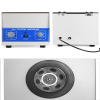
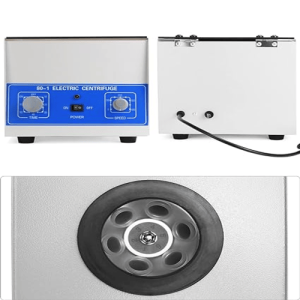
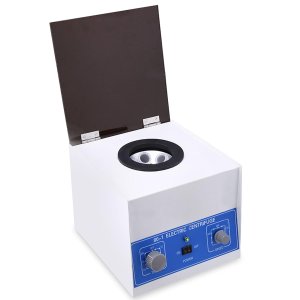
Centrifuge electric is a versatile and user-friendly instrument designed for basic separation tasks in various laboratory settings. It utilizes centrifugal force generated by a spinning rotor to separate mixtures containing suspended particles. This benchtop centrifuge offers a compact design, making it ideal for laboratories with limited space.
Core Functionality:
Separation by Centrifugal Force: The centrifuge operates by spinning a rotor at speeds ranging from 0 to 4000 rotations per minute (RPM). This creates centrifugal force, which pushes denser particles in the mixture outwards from the center of rotation, while lighter components, like fluids, migrate inwards. This segregation allows for the collection of distinct layers or fractions within the original mixture.
Components:
Motor: The electrical motor drives the rotor, generating the centrifugal force required for separation.
Rotor: This central rotating disc holds the centrifuge tubes. It’s typically made of a durable material like metal to withstand the forces involved during operation.
Centrifuge Tubes (6 x 20ml): These sealed tubes, usually made of plastic, hold the mixture to be separated. The 6-tube capacity allows for processing multiple samples simultaneously (each with a maximum volume of 20 milliliters).
Lid: A secure lid with a latch keeps the tubes in place during operation and prevents them from dislodging due to the centrifugal force.
Control Panel: The panel allows you to set parameters for centrifugation, including:
Speed: This knob or button allows you to adjust the rotational speed of the rotor within the 0-4000 RPM range.
Timer: This feature allows you to set the duration of the centrifugation process, typically ranging from 0 to 60 minutes (depending on the specific model).
Applications:
Biological Separations: In biology and medicine, Model 80-1 can be used for basic cell separations, isolating bacteria from liquid cultures, or pelleting precipitates.
Chemical Separations: Chemists can utilize this centrifuge for simple tasks like clarifying suspensions or separating precipitates from solutions.
Environmental Applications: This equipment can be used in environmental analysis for basic separations of suspended solids from water samples.
Benefits:
Compact Design: The small footprint makes it suitable for laboratories with limited bench space.
Easy to Use: The simple controls with a speed knob and timer make operation straightforward for users of all experience levels.
Versatility: Suitable for various basic separation tasks in biology, chemistry, and environmental science.
Multiple Sample Processing: The 6-tube capacity allows for processing multiple samples simultaneously, improving efficiency.
Affordable Option: This model is generally a cost-effective choice for basic laboratory separations




Reviews
There are no reviews yet.